AC Mitigation
Local Presence. Global Expertise. Unmatched in AC Mitigation Across the Region. Proven on Projects Worldwide.
End-to-End AC Mitigation — Assessment to Assured Performance
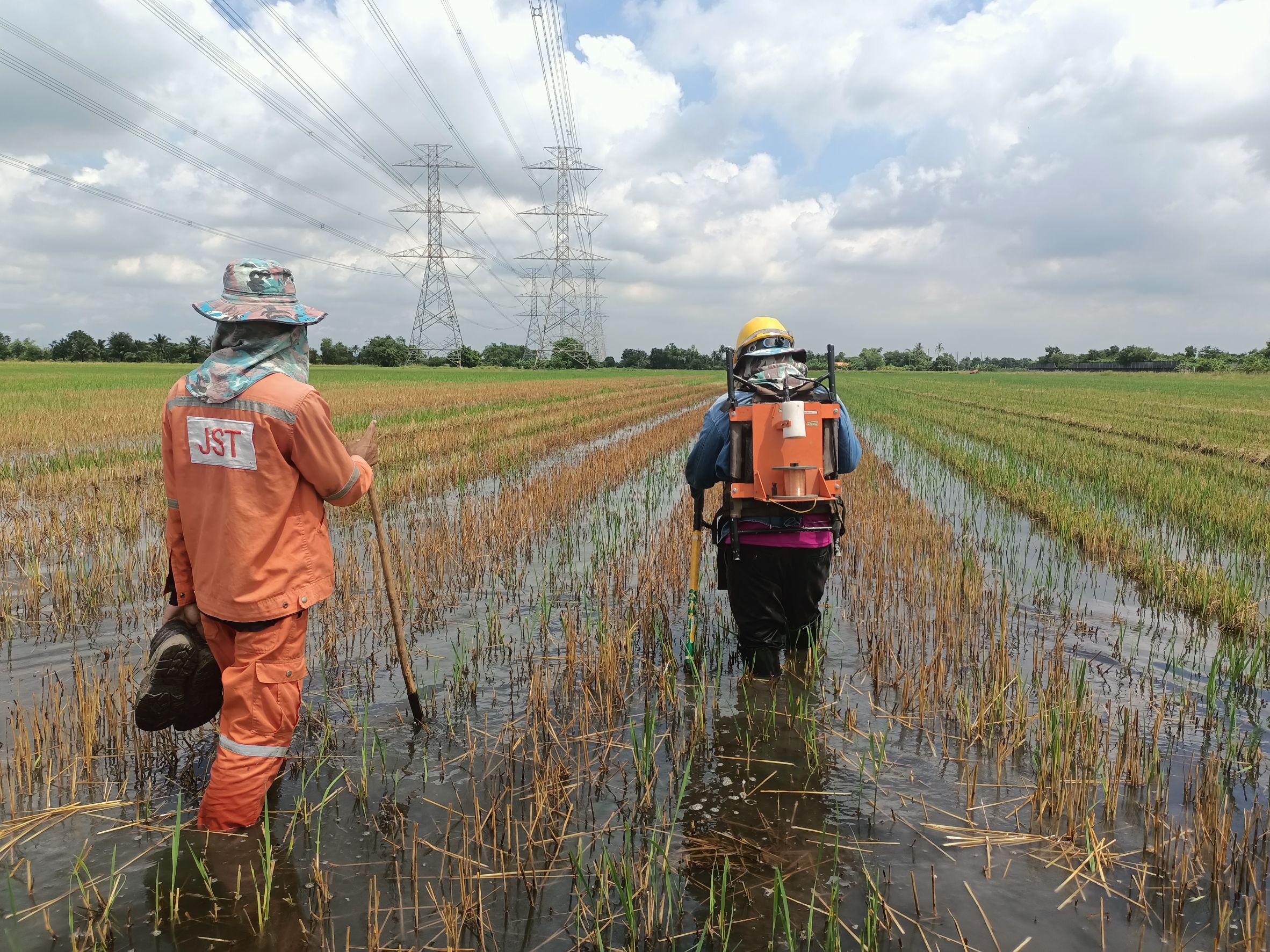
JST delivers complete AC mitigation solutions — from field survey and data capture through modelling, design, installation, commissioning, and ongoing operation.
We combine engineering expertise with proven technologies — working in partnership with industry leaders including Dairyland Electrical Industries (DEI), GPT, BORIN®, and Cosasco — to deliver systems that are technically robust, reliable, and field-proven.
We don’t just assess risk — we engineer, implement, and verify solutions that perform under real operating conditions.
End-to-End Delivery
A disciplined, phased approach from initial assessment through long-term performance assurance.
Survey & Data Collection
Field measurement of induced voltages, AC current densities, coating condition, and interference sources to identify risk and define mitigation requirements.
Modelling & Analysis
Detailed electromagnetic modelling of pipeline and transmission systems to quantify induced voltages and current densities under both steady-state and fault conditions.
Design & Engineering
Development of mitigation strategies tailored to site-specific conditions, including:
- Grounding and gradient control systems
- Decoupling and fault current control devices
- Pipeline isolation and electrical segmentation
- Monitoring and verification systems
Utilising proven technologies from
Dairyland Electrical Industries
Solid-state decouplers, polarization cells, grounding solutions

GPT
Isolation joints, flange insulation systems

Cosasco
Monitoring systems for AC current density and corrosion verification
All integrated into engineered mitigation solutions.
Installation, Commissioning & Testing
Field installation of mitigation systems with verification of performance, including touch voltage, step voltage, and AC current density compliance.
Operation, Monitoring & Inspection
Ongoing monitoring and inspection to ensure sustained performance, including validation of mitigation effectiveness and adjustment as operating conditions evolve.
Engineering Response
Effective AC mitigation requires more than modelling — it requires engineering judgement and the correct application of proven technologies.
JST ensures that every mitigation system is grounded in real-world operating conditions, implemented with field-tested components, and verified to meet both safety and corrosion control criteria.
Designed based on actual operating conditions and risks
Implemented using proven, field-tested components
Verified against safety and corrosion control criteria
Maintained to ensure long-term performance
Why AC Modelling and Mitigation Matters
Increasing infrastructure demand has driven widespread co-location of buried pipelines with overhead high-voltage transmission systems. As proximity increases, so does the risk of AC interference.
Safety risks to personnel and the public
Accelerated coating degradation
AC-induced corrosion — even on otherwise protected systems
Understanding and controlling these risks requires disciplined engineering analysis.
Understanding the Mechanism
AC interference arises from electromagnetic coupling between transmission lines and nearby pipelines.
- Parallel alignment results in maximum coupling
- Perpendicular crossings significantly reduce coupling
- Induced voltage is influenced by electrical loading, geometry, soil conditions, and coating performance
In addition to steady-state conditions, fault events generate ground potential gradients that can impose significant transient voltages — posing both integrity and safety risks.
A Brief History
The safety and corrosion risks associated with induced alternating current (AC) on cathodically protected steel were first identified in laboratory studies in the early 1960s. However, it was not until the mid-1970s — driven by increasing co-location of pipelines with high-voltage AC transmission systems — that the scale and severity of the problem became fully recognised.
In response, the Pipeline Research Council International, in collaboration with the Electric Power Research Institute, initiated a joint research programme into AC interference mechanisms and mitigation methods. The landmark findings, published in 1978 by J. Dabkowski and A. Taflove, established the technical foundation still referenced today.
Advances in computational capability have since transformed AC modelling. Modern simulation tools enable accurate prediction of induced voltages and current densities, allowing operators to design and maintain effective mitigation systems with confidence.
Applicable Standards & Codes
- NACE SP0177 – Mitigation of Alternating Current and Lightning Effects on Metallic Structures and Corrosion Control Systems
- CEN/TS 15280 – Evaluation of AC Corrosion Likelihood of Buried Pipelines
- EN 50443 – Effects of Electromagnetic Interference on Pipelines
- PRCI (Pipeline Research Council International) Modeling Guidelines
- IEC 60479 – Effects of Current on Human Beings
Typical Applications
- Buried oil and gas transmission pipelines
- Distribution pipelines near HV power lines or electrical railways
- Urban pipeline crossings with traction systems
- Gas distribution networks in industrial corridors
- Water and wastewater pipelines
- Offshore-to-onshore export pipeline landfall sections
Industries We Serve This In
Engineering-Led Solutions. Delivered with Proven Technology.
Our AC mitigation engineers are ready to evaluate your situation and design a compliant, cost-effective solution.